LinkedIn has two big things going for it as an ABM channel. The first is its audience: 1.4 billion users, and more business executives than any other platform. The second is control over who sees your content. That one takes a bit more explaining, and it starts with how demand gets created.
The platform has real limits too, and they’re worth knowing upfront, because you can only plan around the limits you know about. So we’ll go through both, plus how much of the buyer journey LinkedIn can cover depending on what you sell.
Why ABM depends on distribution
Demand doesn’t come out of nowhere. It comes from the content buyers consume. When Dreamdata surveyed 3.5 million buyer journeys, it found that buyers spend most of the journey educating themselves and consuming content.
Here’s a simple version of how that plays out. Say you’ve published 10 articles with your POV on a problem your market has. A reader who gets through 7 of them comes out needing what you sell, and reaches out as an inbound lead.
Real journeys aren’t always that neat, and not every buyer takes the same path. But the basics don’t change: if buyers don’t actually consume your content, they never develop a need for what you sell, and without that demand there’s nothing to move into your pipeline. So if you want to generate pipeline actively, you can’t just wait and hope your content reaches those accounts. You have to get it in front of the accounts you’re going after, and that’s what distribution does.
What organic distribution leaves to chance
Organic distribution is the waiting game. You publish on your website, YouTube channel or LinkedIn, and buyers come across it on their own. That can still bring in inbound leads, but three things are out of your hands. Back to the 10 articles:
Only buyers who are searching find your articles. And people only search for problems they know they have. Plenty of buyers don’t know yet, and educating them is a big part of what demand generation does. Organic distribution misses those buyers, and with them, a lot of the accounts you’re going after.
Discovery and distribution are random. Whether your first article reaches an account tomorrow or a week from now is down to luck. So is how much of your content reaches it: a buyer there might read 1 article and never get to 7.
You don’t know who’s reading. Demand alone won’t take an account from cold to pipeline. It still has to be activated, meaning moved into your sales pipeline. Timing matters too: wait too long, and a competitor can step in and win an account you warmed up. And you can only activate the accounts where you know your content is being consumed.
How paid LinkedIn gives you control
This is where paid LinkedIn comes in: it lets you take control of the parts organic distribution leaves to chance. It tackles all three problems above, even if it doesn’t fully solve every one of them.
Your content reaches the accounts on your list, searching or not
You upload a list of the companies you’re going after, pick content about a specific problem, and run it as ads to that list. In our example, that’s the difference between your articles reaching 8 or 10 qualified accounts by chance and reaching 100 or 300 because you put them there.
Your content stays in front of them
You’re paying to keep it there, so they don’t have to read it the first time they see it. They might get to it three months later, and your content keeps showing up in the meantime. When they read it is still their call.
You can see engagement at each account
LinkedIn’s company hub shows how many impressions, video views, paid engagements and paid clicks each account on your list had. Most of the clicks on your ads will be See More clicks, from people expanding the ad to read the rest. LinkedIn also tracks dwell time, meaning how long someone spends with your content, though not per account or contact.
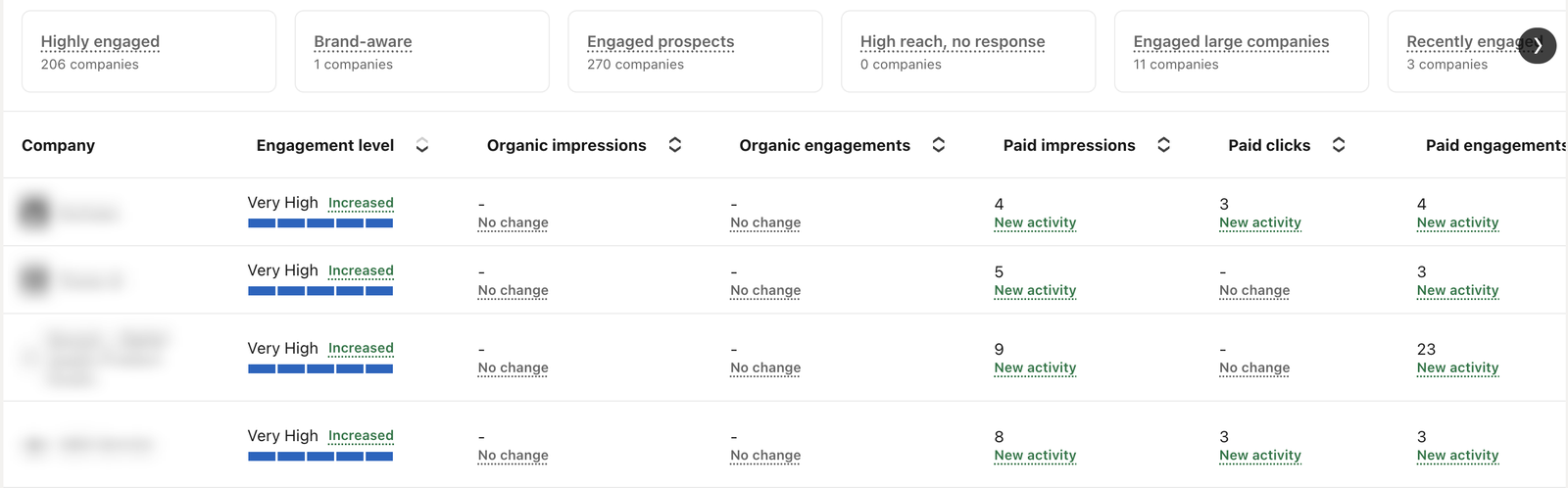
So it’s not a full picture of who’s consuming your content. But it tells you a lot about what’s happening at each account, which is far more to go on than organic gives you when it’s time to activate accounts.
What paid LinkedIn can’t control
Paid LinkedIn can put your content in front of your accounts. It can’t make anyone consume it.
And that last row is the one demand depends on. Getting seen isn’t the same as getting consumed, on paid LinkedIn just like with organic.
That’s a real limit, but two things put it in perspective:
ABM can pay off even if your content doesn’t get consumed at every account. Even if some never do, you’ve still swapped random discovery and distribution for controlled ones.
Paid LinkedIn comes on top of organic, not instead of it. Your organic content keeps reaching the buyers who find it on their own. Paid just adds controlled distribution next to it.
How much of the buyer journey LinkedIn can cover
LinkedIn’s other limit is its native formats, and how much they hold you back depends on what you sell. If your solution is complex, the content that generates demand for it takes a certain mental mode to get through. That’s not the mode people are in on LinkedIn, where what works natively is shallower content.
Three things decide what LinkedIn can do for you and how much of the buyer journey it can carry: your ACV, how complex your solution is and how long your sales cycle runs.
How distribution works for complex, high-ACV solutions is covered in Building your LinkedIn distribution strategy.